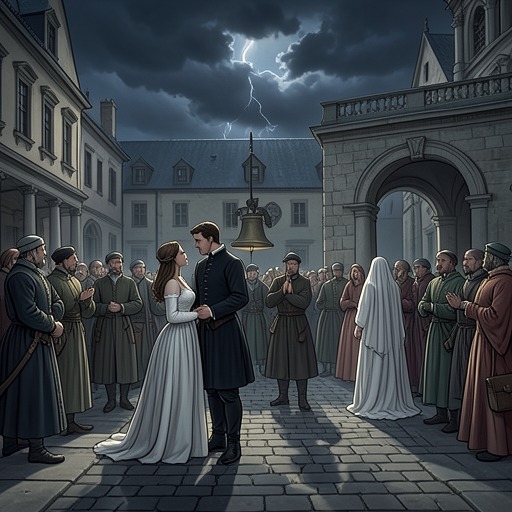
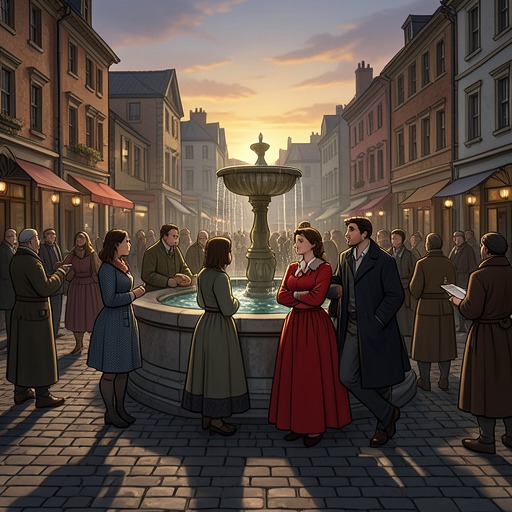
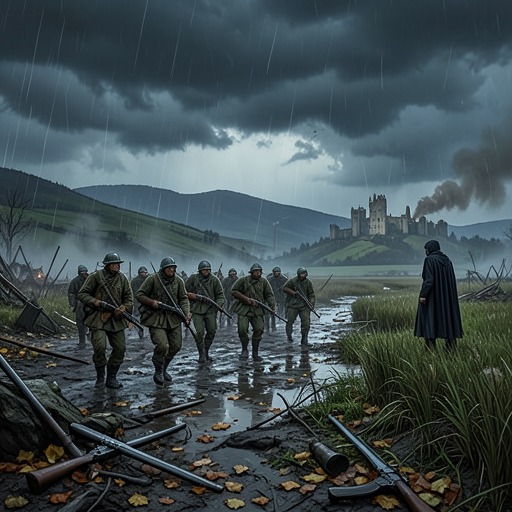
the opening night in Messina
The Prince’s Arrival
A messenger announces that [Don Pedro](entity:character-recall-character-da33e1eb0620) has returned to [Messina](entity:location-recall-location-messina-1492e6c6babb) after the war, accompanied by [Don John](entity:character-recall-character-ca662f55e14b), [Claudio](entity:character-recall-character-4e78258e3f69), [Benedick](entity:character-recall-character-003879abde5d), and their companions. [Leonato](entity:character-recall-character-626fd591ab90) welcomes them to his house, where the atmosphere of victory quickly becomes one of hospitality, flirtation, and renewed rivalry.
The arrival establishes the social world in which the comedy will unfold: military honor is giving way to courtship, and old verbal antagonisms are immediately revived. [Beatrice](entity:character-recall-character-5f067d4cd1cb) and Benedick’s Merry war becomes the liveliest sign that affection may already be hiding beneath hostility.
shortly after the soldiers arrive
Beatrice and Benedick Spar
[Beatrice](entity:character-recall-character-5f067d4cd1cb) mocks [Benedick](entity:character-recall-character-003879abde5d)’s reputation as a soldier, eater, and fickle companion, while Benedick answers with equal sharpness. [Leonato](entity:character-recall-character-626fd591ab90) explains that their encounters are a customary skirmish of wit, revealing a long familiarity that neither character will acknowledge as intimacy.
Their exchange turns hostility into theatrical courtship before either understands it. The scene also defines [Wit](entity:concept-recall-concept-wit-df7a47c67a48) as both armor and attraction: each uses language to prevent emotional vulnerability, yet each is most animated in the other’s presence.
the same evening
Claudio Loves Hero
[Claudio](entity:character-recall-character-4e78258e3f69) privately admits that he has fallen in love with [Hero](entity:character-recall-character-116729669812) after returning from the war. The prince recognizes the seriousness of his desire and promises to woo Hero on Claudio’s behalf, using the evening’s revels and a disguise to gain her hearing.
Claudio’s love redirects the action from military achievement to marriage. [Don Pedro](entity:character-recall-character-da33e1eb0620)’s willingness to act as intermediary also introduces the story’s central vulnerability: love will repeatedly be mediated through performance, report, and disguise rather than direct speech.
later that night
Don John Resents His Brother
[Don John](entity:character-recall-character-ca662f55e14b) tells [Conrade](entity:character-recall-character-a5d00e07bda5) that he refuses to soften his melancholy or disguise his hostility toward [Don Pedro](entity:character-recall-character-da33e1eb0620). Though recently reconciled with his brother, he regards reconciliation as a muzzle and a chain, openly embracing the identity of a villain rather than submitting to gratitude.
His resentment gives the comedy its malicious counterforce. Don John’s determination to remain alienated transforms the coming marriage into an opportunity for revenge, opposing the generous social energy of Don Pedro’s household.
the same night
The Marriage Plot Revealed
[Borachio](entity:character-recall-character-7d2d22656d4d) tells [Don John](entity:character-recall-character-ca662f55e14b) that [Claudio](entity:character-recall-character-4e78258e3f69) is to marry [Hero](entity:character-recall-character-116729669812). He has overheard [Don Pedro](entity:character-recall-character-da33e1eb0620)’s plan to woo Hero first and then transfer her to Claudio, and he offers this knowledge as material for mischief.
Don John seizes on the arrangement because Claudio’s happiness is linked to his brother’s honor. Borachio’s information makes the forthcoming union a target and begins the chain of [Deception](entity:concept-recall-concept-deception-f692ccc64944) that will turn apparent proof against Hero.
that night at Leonato’s house
The Masked Revels
The household holds a masked dance. [Hero](entity:character-recall-character-116729669812) resists [Don Pedro](entity:character-recall-character-da33e1eb0620)’s playful advances, [Margaret](entity:character-recall-character-00d8a2eecfca) and [Balthasar](entity:character-recall-character-55b5d63f7e07) exchange flirtatious jokes, and the masks allow the guests to speak with unusual freedom while concealing their identities.
The revels dramatize the unstable relation between appearance and truth. [Disguise and masking](entity:concept-recall-concept-disguise-and-masking-496e944e71d2) permit courtship, but they also create the conditions for [Claudio](entity:character-recall-character-4e78258e3f69) to misread Don Pedro’s conversation and for later accusations to seem credible.
during the masked revels
Claudio Misreads Don Pedro
[Don John](entity:character-recall-character-ca662f55e14b) and [Borachio](entity:character-recall-character-7d2d22656d4d) tell [Claudio](entity:character-recall-character-4e78258e3f69) that [Don Pedro](entity:character-recall-character-da33e1eb0620) intends to marry [Hero](entity:character-recall-character-116729669812) for himself. Claudio, concealed behind a mask, believes the report and concludes that his friend has betrayed him, even though Don Pedro is actually working to secure Hero for him.
The incident exposes Claudio’s readiness to trust appearances and hearsay over friendship. [Jealousy](entity:concept-recall-concept-jealousy-6a9746ea8d19) enters the story before the marriage has even been arranged, foreshadowing the much darker suspicion that will later destroy Hero’s reputation.
later during the same revels
Don Pedro Wins Hero
[Don Pedro](entity:character-recall-character-da33e1eb0620) reveals that he has successfully wooed [Hero](entity:character-recall-character-116729669812) in [Claudio](entity:character-recall-character-4e78258e3f69)’s name and obtained [Leonato](entity:character-recall-character-626fd591ab90)’s approval. Claudio is formally promised to Hero, though his earlier suspicion leaves him subdued rather than openly joyful.
The betrothal appears to settle the main romantic plot, but it also confirms that the lovers’ relationship has been created through substitution and mediation. The apparent success of the disguise therefore carries the seed of future misunderstanding.
after the betrothal that night
The Double Courtship Scheme
[Don Pedro](entity:character-recall-character-da33e1eb0620), [Leonato](entity:character-recall-character-626fd591ab90), [Claudio](entity:character-recall-character-4e78258e3f69), and [Hero](entity:character-recall-character-116729669812) agree to trick [Beatrice](entity:character-recall-character-5f067d4cd1cb) and [Benedick](entity:character-recall-character-003879abde5d) into falling in love. They plan to speak within Benedick’s hearing about Beatrice’s supposed passion, while Hero and her gentlewomen will stage a corresponding conversation for Beatrice.
The plot treats courtship as a social performance capable of correcting pride. Unlike [Don John](entity:character-recall-character-ca662f55e14b)’s deception, the scheme is benevolent, but it still depends on controlled appearances and carefully planted words.
the following day
Borachio’s Window Plot
[Don John](entity:character-recall-character-ca662f55e14b) asks how the marriage can be prevented. [Borachio](entity:character-recall-character-7d2d22656d4d) proposes to court [Margaret](entity:character-recall-character-00d8a2eecfca) while calling her [Hero](entity:character-recall-character-116729669812) at Hero’s chamber window, then arrange for [Don Pedro](entity:character-recall-character-da33e1eb0620) and [Claudio](entity:character-recall-character-4e78258e3f69) to witness the scene. He predicts that the apparent sight will prove Hero’s disloyalty and overturn the wedding.
The plan weaponizes the same elements that made the benevolent courtship scheme effective: disguise, distance, and overheard speech. Its power depends less on truth than on the observers’ willingness to turn suspicion into certainty.
the next day in Leonato’s orchard
Benedick Hides in the Orchard
[Benedick](entity:character-recall-character-003879abde5d) reflects on [Claudio](entity:character-recall-character-4e78258e3f69)’s transformation under love and insists that he himself will remain a bachelor. He declares that no single woman could possess all the qualities he demands, then hides in the arbor when [Don Pedro](entity:character-recall-character-da33e1eb0620), Claudio, and [Leonato](entity:character-recall-character-626fd591ab90) enter.
His speech reveals that his resistance is less a settled philosophy than a defensive pose. By placing him in the orchard as an unseen listener, the staging turns his proud declarations into the immediate prelude to their undoing.
shortly afterward in Leonato’s orchard
Benedick Hears Beatrice Loves Him
[Don Pedro](entity:character-recall-character-da33e1eb0620), [Claudio](entity:character-recall-character-4e78258e3f69), and [Leonato](entity:character-recall-character-626fd591ab90) stage a conversation declaring that [Beatrice](entity:character-recall-character-5f067d4cd1cb) is desperately in love with [Benedick](entity:character-recall-character-003879abde5d) but too proud to confess it. They describe her imagined suffering in extravagant detail, while Benedick secretly listens and takes the performance for truth.
The trick succeeds because it gives Benedick a flattering interpretation of his own importance while preserving his belief that he is acting rationally. He begins to reconsider marriage, pride, and his own identity as a confirmed bachelor.
immediately after the orchard deception
Benedick Accepts Love
[Benedick](entity:character-recall-character-003879abde5d) concludes that [Beatrice](entity:character-recall-character-5f067d4cd1cb) must love him and resolves to requite her. He admits that he will become horribly in love, even though he had sworn never to marry, and reads her brief summons to dinner as evidence of hidden affection.
His conversion is comic because his language remains argumentative even as his emotional position changes completely. [Love](entity:state-recall-state-b23a4df90aab) has not silenced his [Wit](entity:concept-recall-concept-wit-df7a47c67a48); it has redirected it toward self-persuasion.
the next morning in Leonato’s garden
Beatrice Hears Benedick Loves Her
[Hero](entity:character-recall-character-116729669812) instructs [Margaret](entity:character-recall-character-00d8a2eecfca) to bring [Beatrice](entity:character-recall-character-5f067d4cd1cb) near the pleached bower, where Hero and [Ursula](entity:character-recall-character-afd015976dfd) pretend to discuss [Benedick](entity:character-recall-character-003879abde5d)’s love for her. They praise his courage, intelligence, and reputation while claiming that Beatrice’s pride makes him suffer in silence.
Beatrice overhears the staged conversation and recognizes the cruelty of her former disdain. The trick forces her to imagine herself from another person’s perspective, making humility and reciprocity possible.
immediately after hearing the staged conversation
Beatrice Chooses Love
[Beatrice](entity:character-recall-character-5f067d4cd1cb) emerges from hiding and resolves to abandon contempt and maiden pride. She promises to answer [Benedick](entity:character-recall-character-003879abde5d)’s love and submit her wild heart to a loving bond, accepting the report because she believes he deserves affection.
Her change is more inwardly reflective than Benedick’s. She does not merely believe she is desired; she judges that love requires her to revise the pride that has governed her conduct.
the day before the wedding
Don John Warns of Hero
[Don John](entity:character-recall-character-ca662f55e14b) tells [Don Pedro](entity:character-recall-character-da33e1eb0620) and [Claudio](entity:character-recall-character-4e78258e3f69) that [Hero](entity:character-recall-character-116729669812) is disloyal and offers to show them a man entering her chamber window on the night before the wedding. Claudio declares that, if he sees proof, he will shame Hero publicly at the altar.
The accusation succeeds because Claudio and Don Pedro are already prepared to trust visual evidence over Hero’s character. Don John converts their concern for [Honor](entity:concept-recall-concept-honor-bbb8298ae7ac) into a weapon against the woman whose reputation depends on it.
that same night in the streets of Messina
The Watch Receives Its Charge
[Dogberry](entity:character-recall-character-d6cf3f9a8b50) and [Verges](entity:character-recall-character-f289a08a3e00) instruct [the Watch](entity:organization-recall-organization-the-watch-7f1138ed48a5) to patrol the streets, manage drunkards, and guard [Leonato’s house](entity:location-recall-location-b6cc7918b51b) before the wedding. Their pompous misunderstandings make them appear incompetent, yet their accidental presence will become decisive.
The scene places comic civic disorder beside aristocratic emotional disorder. The Watch’s ordinary vigilance will uncover the villainy that the princes, despite their status and intelligence, fail to recognize.
late that night
Borachio Confesses to Conrade
[Borachio](entity:character-recall-character-7d2d22656d4d) tells [Conrade](entity:character-recall-character-a5d00e07bda5) that he has earned a thousand ducats by carrying out [Don John](entity:character-recall-character-ca662f55e14b)’s plan. He explains that he courted [Margaret](entity:character-recall-character-00d8a2eecfca) while calling her [Hero](entity:character-recall-character-116729669812), and that [Don Pedro](entity:character-recall-character-da33e1eb0620) and [Claudio](entity:character-recall-character-4e78258e3f69) watched from the orchard and mistook her identity.
He also reveals that Claudio intends to denounce Hero before the entire congregation. The confession supplies the truth that the noblemen lacked, but its discovery depends on [the Watch](entity:organization-recall-organization-the-watch-7f1138ed48a5) overhearing a conversation the conspirators believe private.
immediately after Borachio’s confession
The Watch Arrests the Conspirators
The Watch arrests [Borachio](entity:character-recall-character-7d2d22656d4d) and [Conrade](entity:character-recall-character-a5d00e07bda5) after hearing their account of the plot. Their comic confusion about charges and legal language does not prevent them from preserving the evidence that will eventually expose [Don John](entity:character-recall-character-ca662f55e14b).
The arrest marks the first reversal against the villains. Truth enters the story through the least authoritative characters, demonstrating that social rank and rhetorical confidence are poor guarantees of judgment.
the morning of the wedding
Hero Prepares for Marriage
[Hero](entity:character-recall-character-116729669812) dresses for her marriage while [Margaret](entity:character-recall-character-00d8a2eecfca) teases her about clothing, husbands, and the heaviness of marriage. [Beatrice](entity:character-recall-character-5f067d4cd1cb), newly affected by love, struggles to maintain her old verbal manner but cannot conceal her unease.
The light domestic scene intensifies the coming catastrophe by showing Hero and her companions expecting joy. Margaret’s innocent wordplay will soon be misread as evidence of sexual corruption, making the gap between intention and interpretation painfully clear.
the morning of the wedding in the church
The Wedding Accusation
At the church, [Claudio](entity:character-recall-character-4e78258e3f69) refuses [Hero](entity:character-recall-character-116729669812) and publicly calls her an unchaste woman. [Don Pedro](entity:character-recall-character-da33e1eb0620) confirms the accusation, claiming that he, [Don John](entity:character-recall-character-ca662f55e14b), and Claudio saw her speaking with a man at her window during the night.
Hero denies the encounter, but Claudio treats her blushes and outward appearance as proof of guilt. The ceremony becomes a public trial in which [Slander](entity:concept-recall-concept-slander-de303d608f81) overwhelms character, and the social order turns against an innocent bride.
during the church denunciation
Hero Collapses
[Hero](entity:character-recall-character-116729669812) faints after [Claudio](entity:character-recall-character-4e78258e3f69)’s accusation, and [Leonato](entity:character-recall-character-626fd591ab90) initially wishes that death would conceal the shame he believes she has brought upon him. [Beatrice](entity:character-recall-character-5f067d4cd1cb) calls for help, while [Benedick](entity:character-recall-character-003879abde5d) is stunned by the violence of the scene.
The collapse makes the private cost of public [Honor](entity:concept-recall-concept-honor-bbb8298ae7ac) visible. Hero’s body becomes the apparent evidence of guilt to those who judge her, even as her silence and vulnerability expose the cruelty of the accusation.
immediately after the failed wedding
The Friar Defends Hero
[Friar Francis](entity:character-recall-character-48c72d774b8b) argues that [Hero](entity:character-recall-character-116729669812)’s blushing, innocence, and demeanor reveal that she has been falsely accused. Hero swears that she spoke with no man during the alleged hour and asks to be punished if any accusation can be proved.
The friar introduces a form of judgment based on sustained observation rather than spectacle. His confidence prevents [Leonato](entity:character-recall-character-626fd591ab90) from destroying Hero and opens the possibility that the false story can be countered without further exposing her to public shame.
later that morning
Hero’s Death Is Faked
[Friar Francis](entity:character-recall-character-48c72d774b8b) advises [Leonato](entity:character-recall-character-626fd591ab90) to conceal [Hero](entity:character-recall-character-116729669812) and announce that she has died. A public mourning and the apparent burial will transform the accusation into remorse and allow [Claudio](entity:character-recall-character-4e78258e3f69) to feel the value of what he has rejected.
The plan is a dangerous moral experiment, but it gives Hero protection while preserving a path toward recognition. It also reverses the logic of the accusation: only the loss of the supposedly disgraced woman may force the men to reassess her worth.
immediately after the church crisis
Beatrice Demands Claudio’s Death
[Beatrice](entity:character-recall-character-5f067d4cd1cb) and [Benedick](entity:character-recall-character-003879abde5d) remain behind after the others leave. Benedick confesses that he loves Beatrice, and she admits that she loves him, but her grief for [Hero](entity:character-recall-character-116729669812) turns the confession into a demand: Benedick must challenge [Claudio](entity:character-recall-character-4e78258e3f69).
Benedick accepts the challenge because love has changed the meaning of his [Honor](entity:concept-recall-concept-honor-bbb8298ae7ac). His former Merry war was verbal and playful; now affection requires action against a friend who has publicly destroyed Beatrice’s cousin.
later that day in the prison
Dogberry Examines the Prisoners
[Dogberry](entity:character-recall-character-d6cf3f9a8b50), [Verges](entity:character-recall-character-f289a08a3e00), the [Sexton](entity:character-recall-character-64e0b6ebd212), and [the Watch](entity:organization-recall-organization-the-watch-7f1138ed48a5) question [Borachio](entity:character-recall-character-7d2d22656d4d) and [Conrade](entity:character-recall-character-a5d00e07bda5). Their malapropisms and procedural confusion produce comedy, but the Watch’s testimony establishes that Borachio accepted payment from [Don John](entity:character-recall-character-ca662f55e14b) and helped arrange [Hero](entity:character-recall-character-116729669812)’s disgrace.
The Sexton recognizes the significance of the evidence and orders the prisoners taken to [Leonato](entity:character-recall-character-626fd591ab90). The truth is now formally preserved, even though those who first uncovered it are mocked as fools.
the following day outside Leonato’s house
Leonato Challenges Claudio
[Leonato](entity:character-recall-character-626fd591ab90), consumed by grief, confronts [Don Pedro](entity:character-recall-character-da33e1eb0620) and [Claudio](entity:character-recall-character-4e78258e3f69) and accuses Claudio of killing [Hero](entity:character-recall-character-116729669812) through slander. He challenges the younger man despite his age, while [Antonio](entity:character-recall-character-de4c55c60063) joins the quarrelsome defense of their family.
The confrontation reveals how completely public accusation has damaged the older generation. Leonato’s grief becomes a demand that social power answer for the misuse of [Honor](entity:concept-recall-concept-honor-bbb8298ae7ac), even though Claudio refuses to fight him directly.
shortly after Leonato’s confrontation
Benedick Challenges Claudio
[Benedick](entity:character-recall-character-003879abde5d) meets [Don Pedro](entity:character-recall-character-da33e1eb0620) and [Claudio](entity:character-recall-character-4e78258e3f69) and refuses their attempts to revive their old joking companionship. He privately tells Claudio that he is a villain and challenges him to answer for [Hero](entity:character-recall-character-116729669812)’s death, then breaks with Don Pedro as well.
The challenge confirms Benedick’s transformation from bachelor wit to committed moral actor. His loyalty now belongs to [Beatrice](entity:character-recall-character-5f067d4cd1cb) and Hero’s innocence rather than to the masculine fellowship that once defined him.
the same day
Borachio Confesses the Truth
[Dogberry](entity:character-recall-character-d6cf3f9a8b50)’s prisoners are brought before [Don Pedro](entity:character-recall-character-da33e1eb0620) and [Claudio](entity:character-recall-character-4e78258e3f69). [Borachio](entity:character-recall-character-7d2d22656d4d) openly explains that [Don John](entity:character-recall-character-ca662f55e14b) paid him to deceive them, that [Margaret](entity:character-recall-character-00d8a2eecfca) was mistaken for [Hero](entity:character-recall-character-116729669812) at the window, and that the entire accusation was fabricated.
Claudio realizes that he has destroyed an innocent woman through a false appearance. His remorse is immediate and physical, while Don Pedro recognizes that his brother has been wholly shaped by treachery.
immediately after Borachio’s confession
Claudio Learns Hero Is Innocent
[Claudio](entity:character-recall-character-4e78258e3f69) learns that [Hero](entity:character-recall-character-116729669812)’s death was caused by the slanderous plot and sees her again in his imagination as the woman he first loved. [Don Pedro](entity:character-recall-character-da33e1eb0620) confirms that [Don John](entity:character-recall-character-ca662f55e14b) has fled, while [Leonato](entity:character-recall-character-626fd591ab90) rejects [Borachio](entity:character-recall-character-7d2d22656d4d)’s attempt to claim sole responsibility because the absent Don John also participated.
The revelation restores factual truth but cannot restore Hero’s lost life or reputation by simple acknowledgment. Claudio must now undergo public penance and accept that his judgment, not merely Don John’s scheme, caused the tragedy.
later that day
Leonato Sets Claudio’s Penance
[Leonato](entity:character-recall-character-626fd591ab90) tells [Claudio](entity:character-recall-character-4e78258e3f69) to proclaim [Hero](entity:character-recall-character-116729669812)’s innocence, place an epitaph on her tomb, and mourn her publicly. He then offers Claudio a second marriage to [Antonio](entity:character-recall-character-de4c55c60063)’s daughter, who is said to resemble Hero, making Claudio Leonato’s nephew if he fulfills the obligation.
The arrangement is both punishment and opportunity. Leonato cannot command Hero back to life, but he can make Claudio serve the truth and enter the family under terms that preserve Hero’s place in its memory.
that midnight
Claudio Mourns at Hero’s Tomb
[Claudio](entity:character-recall-character-4e78258e3f69) visits the monument where [Hero](entity:character-recall-character-116729669812) is believed to lie and reads an epitaph declaring that slander killed her but could not destroy her fame. He orders a solemn hymn and promises to repeat the mourning rite every year.
The ritual turns private remorse into public memory. Claudio cannot undo his accusation, but he begins the labor of restoring Hero’s [Honor](entity:concept-recall-concept-honor-bbb8298ae7ac) by making his own voice serve the truth that once escaped him.
the next day in Leonato’s garden
Benedick and Beatrice Reunite
[Benedick](entity:character-recall-character-003879abde5d) asks [Margaret](entity:character-recall-character-00d8a2eecfca) to bring [Beatrice](entity:character-recall-character-5f067d4cd1cb) to him and speaks with her about [Claudio](entity:character-recall-character-4e78258e3f69)’s challenge. Their conversation remains full of verbal reversals, but both openly acknowledge that they love one another despite themselves.
Their relationship now joins [Wit](entity:concept-recall-concept-wit-df7a47c67a48) to vulnerability rather than using Wit as a shield against it. They remain incapable of wooing peaceably, yet their quarrel has become a shared language of affection rather than a refusal of intimacy.
immediately afterward
The Truth Reaches Beatrice
[Ursula](entity:character-recall-character-afd015976dfd) tells [Beatrice](entity:character-recall-character-5f067d4cd1cb) that [Hero](entity:character-recall-character-116729669812) was falsely accused, that [Don Pedro](entity:character-recall-character-da33e1eb0620) and [Claudio](entity:character-recall-character-4e78258e3f69) were deceived, and that [Don John](entity:character-recall-character-ca662f55e14b) was responsible before fleeing. Beatrice and [Benedick](entity:character-recall-character-003879abde5d) return to [Leonato’s house](entity:location-recall-location-b6cc7918b51b) to hear the matter confirmed.
The revelation gives Beatrice a basis for hope but does not erase the violence done to Hero. Her demand for justice remains morally central, while Benedick’s challenge now appears as part of a larger restoration rather than a private act of romantic loyalty.
the following morning
Claudio Performs Repentance
[Claudio](entity:character-recall-character-4e78258e3f69) and [Don Pedro](entity:character-recall-character-da33e1eb0620) return to [Leonato’s house](entity:location-recall-location-b6cc7918b51b) dressed for the promised marriage and unaware that [Hero](entity:character-recall-character-116729669812) is alive. [Leonato](entity:character-recall-character-626fd591ab90) has arranged for Claudio to marry a masked woman presented as [Antonio](entity:character-recall-character-de4c55c60063)’s daughter, forcing him to commit himself before learning her identity.
Claudio’s willingness to marry even a woman he imagines as Ethiopian shows the depth of his remorse or at least his submission to penance. The staged ceremony prepares a public reversal of the first wedding, where appearance had condemned the innocent.
during the second wedding ceremony
Hero Reveals Herself
[Claudio](entity:character-recall-character-4e78258e3f69) takes the masked woman’s hand and promises to marry her. [Hero](entity:character-recall-character-116729669812) then unmasks and declares that she is the same woman he once loved, alive and still a maid; [Leonato](entity:character-recall-character-626fd591ab90) explains that she died only while the slander against her lived.
The revelation restores Hero’s identity through ceremony, but it also forces Claudio to confront the instability of his own perception. The second marriage can proceed only after truth has displaced the false spectacle of the first.
immediately after Hero’s revelation
Benedick and Beatrice Are Matched
[Benedick](entity:character-recall-character-003879abde5d) and [Beatrice](entity:character-recall-character-5f067d4cd1cb) are asked whether they love each other, and each initially answers with comic denial. [Claudio](entity:character-recall-character-4e78258e3f69) and [Hero](entity:character-recall-character-116729669812) produce letters written by the two lovers, proving that their affection is real despite their evasions.
The written evidence transforms the earlier deceptions into a more durable recognition. Their own hands stand against their guarded hearts, and their marriage becomes an acceptance of mutual persuasion rather than a surrender imposed by authority.
later that morning
The Lovers Reconcile
[Benedick](entity:character-recall-character-003879abde5d) and [Beatrice](entity:character-recall-character-5f067d4cd1cb) agree to marry, though both pretend that pity or persuasion has forced the decision. Benedick forgives [Claudio](entity:character-recall-character-4e78258e3f69) as a future kinsman, and Claudio accepts the reconciliation while continuing to joke about Benedick’s transformation.
The restored fellowship is not a return to the old order. Benedick now admits that he will marry despite everything he once said, while Beatrice retains her independent wit; their union preserves conflict as a form of equality and intimacy.
at the close of the story
Don John Is Captured
A messenger announces that [Don John](entity:character-recall-character-ca662f55e14b) has been captured while fleeing and is being brought back to [Messina](entity:location-recall-location-messina-1492e6c6babb). [Benedick](entity:character-recall-character-003879abde5d) postpones the question of his punishment so that the celebrations may continue.
The arrest completes the external defeat of the villain, while the deeper resolution has already come through confession, repentance, and restored marriages. Don John’s fate is deferred, but the social world he tried to fracture is prepared to reunite in music and dance.
the ending
The Final Dance
[Benedick](entity:character-recall-character-003879abde5d) calls for music and dancing before the marriages, teasing [Don Pedro](entity:character-recall-character-da33e1eb0620) about his sadness and urging him to take a wife. The company prepares to celebrate the unions of [Claudio](entity:character-recall-character-4e78258e3f69) and [Hero](entity:character-recall-character-116729669812) and of Benedick and [Beatrice](entity:character-recall-character-5f067d4cd1cb).
The ending does not erase the wounds caused by [Slander](entity:concept-recall-concept-slander-de303d608f81), but it places them within a renewed communal order. [Wit](entity:concept-recall-concept-wit-df7a47c67a48), love, justice, and performance are finally brought into balance, allowing the play’s Merry war to end not in silence but in shared festivity.